Wednesday, February 19, 2014
Audi 2010 A4 Is All Power With Classleading Fuel Economy By Ronnie W Tanner Platinum Quality Author
 Audi 2010 A4
Audi has presented a new A4 for the 2010 model year that is a significant improvement over its predecessor. The premium sedan features a two liter turbo-charged engine that produces two hundred and eleven horsepower.
The four cylinder turbo is responsive; the quick acceleration is delivered in a controlled manner through a six-speed manual transmission. The engine features four valves per cylinder, with a direct injection fuel system and dual overhead cam shafts. The sedan is also available with the "quattro" all wheel drive system that Audi has been perfecting since the 1980s. In addition to the aforementioned two hundred and eleven horsepower that the engine delivers at six thousand revolutions per minute, the engine also delivers two hundred fifty-eight pounds of torque at four thousand two hundred revolutions per minute.
The Environmental Protection Agency has rated the engine as returning twenty-two miles per gallon in city driving, and thirty miles per gallon on the highway. In comparison, the BMW 3 series base engine (three liter, six cylinder) returns only nineteen miles per gallon in city driving and only twenty-eight miles per gallon in highway driving. It should also be noted that the Audi A4 returns these mileage figures with the all wheel drive system; clearly Audi has succeeded in producing a sedan with excellent performance and great fuel economy. And speaking of performance, the Audi is definitely no slouch in that arena. The two liter turbo-charged engine propels the A4 from zero to sixy miles per hour in seven and three-tenths seconds, and covers a quarter mile in fifteen and one-half seconds. Whether it is in performance, fuel economy, or technical features, Audi has given the A4 the ability to compete with any car in its class.

Tuesday, February 4, 2014
Toyota Prius Hybrid Hit By Brakes Fault
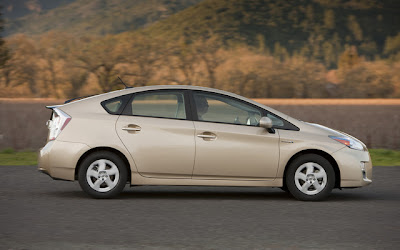
The best selling, Japanese Toyota hybrid car, known as Toyota Prius has received complaints in their brakes mechanism. Analysts project severe revenue downfall due to it.
The new Toyotas gas-electric hybrid car, which was released and became available for sale in Japan and U.S.A in May 2009 has been a best selling model with 4.5 million vehicles already finding their owners.
The U.S. National Highway Traffic Safety Administration has received 180 complaints about the brakes of the Prius new model. The fault involves, remaining of the gas pedal in depressed position.
Two crashes have so far been reported due to this fault resulting in injuries.
Its not the first time as Toyota had received 14 complaints well before in July, last year as claimed by the Japans transport ministry. One of these 14 complaints includes a crash, when a prius at the Japans intersection crashed into another car. This crash also resulted in some injuries as reported by Masaya Ota, a transport ministry official. He further added:
"The Prius driver in the accident told police that a brake did not work," Ota said. "Other Prius drivers also complained brakes were not so sharp." The complaints in Japan involve the new Prius model, and the vehicles were all made in Japan".
The ministry has already ordered an investigation to be held. Toyota spokeswoman Ririko Takeuchi said the company has received reports about the Prius complaints in transparent none repeat scroll North America and in Japan and was now looking into the matter.
As the wise men said "A mistake is not infertile" the Toyota has been hit by some financial implications because of this fault. Its shares drop by 5.7% to 3400 Yen when the stock holders start dumping their shares after this news however 19000 vehicles which have been already imported from Japan to America are not part of the recall. Any serious issue regarding its current fault can result a downfall of an innovative hybrid, eco-friendly car.
Friday, January 31, 2014
Gumpert Tornante by Touring 2011


- Gumpert Tornante by Touring, 2011
Touring Superleggera and Gumpert have chosen the 2011 Geneva Motor Show stage for the world premiere of the Gumpert Tornante. Touring Superleggera provided the design and body engineering while Gumpert will take care of manufacturing and sales of the next model, complementing the Gumpert range as of 2012. The Tornante is showcased at the stage of 1:1 static style model in the best Italian tradition.
Fast Tourer
Gumpert have gained a reputation for their impressive street legal racing cars. They addressed Touring Superleggera with a call for elegance, more passengers and luggage space, improved comfort, access and ventilation, and noise reduction. However, the fundamentals of performance and dynamic properties had to be respected without compromise.
At Touring, designers and body engineers started then a process of creative elimination to define the true essentials of all the parameters involved, limiting unnecessary weight and volume. The result is still a thoroughbred, just a few grades more civilized, with some extra skills for an enjoyable voyage. It is called a Fast Tourer. However, let there be no misunderstanding about its intentions.
Project development
When selecting the partner for the new models body design, Gumpert recognised that elegance is part of the genetic code of Touring Superleggeras creations. Even more remarkably, the paradigm of elegance was applied by Touring to the race cars too. This distinctive approach was at the basis of many masterpieces, like the 1940 Mille Miglia winner BMW 328 Berlinetta, the Ferrari 166 and 340 and the inspiring Alfa Romeo 8C2900. They all were redoubtable race machines with singular grace.
In turn, Touring was intrigued by the challenge from the young, vital and ambitious sports car manufacturer, known for uncompromised orientation to efficiency, high quality engineering and the constant quest for better performance. In the development work, the teams from the two companies discovered soon that they share the same respect for efficiency and essentiality. This facilitated the subsequent stages of engineering and feasibility study, and the merger of body and chassis required only minor adjustments from both sides.
Architecture
The space frame chassis is a derivative of the apollo and features the same central engine layout. However, the requirements of accessibility and inner space have dictated a number of important changes to the rolling chassis:
- the lateral member of the chassis is lowered by 80 mm in the door area
- the A pillar and the windshield are rotated vertically by 2.5°
- the B pillar is moved backwards with 100 mm allowing for 1120 mm wide gull-wing doors
- the H point is displaced by 210 mm in height and 46 mm in length
- the overall height is now 1215 mm
Other modifications aim at enhanced ride comfort and drive ability:
- the floor height is increased by 20 mm
- the shell seats are fully adjustable, heated, with 4-point belts
- the paddle shifters are standard feature
- sound and heat insulation material is fitted on the floor and between the cabin and the engine compartment
- glasses are double layer for better heat and noise insulation
- the ventilation system capacity is improved
Design
Unlike other Touring creations, the Gumpert Tornante is not rooted into a specific model of the Italian designers heritage. Aesthetically, the project started from a white sheet of paper, allowing the designers full and free focus on the challenging package of the rolling chassis and its hard points. The new model should not only offer ample performance and superb dynamic properties and aerodynamics, but also adequate levels of comfort, interior space and ergonomics. The spirit of a true dream car, but with sufficient practical features to become a safe and useable sports car in todays traffic.
The Touring accent of the Gumpert Tornante originates from specific proportions and the balance of muscular elegance and introvert power, rather than formal language. The bodywork preserves its movement even when the car stands still, and when on the move, it expresses unique, elegant fluidness.
The prominent grille within the balanced front wings characterizes the Tornantes front area. The air intakes are pronounced, lecting the care given to the air intake surface and the overall airflow.
The well-defined waistline lects the functional separation between the greenhouse and the lower body. The top is a light area offering extended space for driver and passenger, overall visibility and sportive but comfortable life on board. The muscular, though elegant shoulders announce the stunning performance of the power unit. Both the Gumpert Tornantes doors and the boot lid open with gull-wing movement, providing easy access to the interior, the mechanics and the luggage compartment.
From the rear, the low quarter panels outline the powerful curve of the roof. Below the waistline, the very visible air diffuser evokes the research of the maximal downforce.
The overall design breaths superior potential and performance in an elegant and slightly understated way, faithful to the Touring tradition.
Power Unit
The Gumpert Tornante has the genes of the Gumpert apollo and inherits its impressive V8 biturbo engine. Weighing only 196 kg, the engine plays a major role in ensuring the ideal weight and the fascinating driving dynamics of the Tornante. An angle of 90° between the two cylinder banks is a sign of a classic 8-cylinder engine.
Starting from the pure block from Audi, the engine is a complete in-house development. Thus, the manufacturing process contains among others all the moving parts, air and fuel management, turbo chargers, charge air-duct and dry sump lubrication. In the basic version this engine delivers 700 HP. In comparison to the apollo, the configuration will be optimized for the Fast Touring mission. This means more comfort and more suitability for daily use.
Alongside the V8 power unit, an alternative powered Gumpert Tornante is also planned for 2012.
Driveline
The fully synchronised, automatic six-speed transmission guarantees efficient utilization of the remarkable energy at the back wheels. The arrangement of the gears in a longitudinal direction in the path of travel ensures a very low centre of gravity and optimum weight distribution.
Extremely short gearshifts up to 40 milliseconds (torque-to-torque) are provided by the precise TT40e transmission of the apollo, where "e" stands for electronic gear system. Gear changes are faster thanks to rocker switches on the steering wheel. The Formula 1-type technology promises the ultimate in comfort along with best driving performance.
Suspension
The apollo derived built-in suspension ideally complements the bodys sophisticated aerodynamics. The Tornante owes the finely tuned sensitivity of the suspension system and the optimised exertion of power to its double transverse control arm pushrod configuration at front and rear.
The double wishbones ensure that the tires maintain optimum contact to the road surface, independently of the bound rate of suspension system. As the suspension elements are linked to the main frame, the system ensures a responsive reaction and precise handling.
Chassis
Made of top-quality and highly stable chrome-molybdenum-steel with an integrated safety cell, the round tube frame is the base and symbolic backbone of the Gumpert Tornante. Providing additional space and comfort for its passengers compared to the apollo, the Tornante will be as safe as its racetrack-dedicated brother is. The Gumpert Tornante succeeds in combining low weight and rigidity with finest driving dynamics and comfortable Fast Touring.
TECHNICAL DATA
2-seater sports car with a mid-engine arrangement, chrome-molybdenum steel chassis with an integrated safety cell, doors and the boot lid open with gull-wings, carbon body, 100 l stainless steel tank behind the passenger cell with integrated catch tank, long and pushrod-operated double transverse control arm suspension with fully adjustable dampers (front and rear) and anti roll bar in front, ground clearance adjustable between 60 and 140 mm, two circuit ABS brake system with six piston callipers, inside ventilated discs (378 x 32 mm) at front and rear
Dimensions
Length: 4,475 mm
Width: 1,971 mm
Height: 1,215 mm
Wheel base: 2,700 mm
Track
front: 1,648 mm
back: 1,600 mm
Boot volume: ca. 200 l
Weight
Kerb weight (depending on equipment components): 1,300-1,400 kg
Engine
V8 cylinder biturbo engine with 90° cylinder angle, closed-deck light metal crankcase, light metal cylinder heads with five valves per cylinder, four overhead camshafts, variable time of ignition (Vario Cam direct) on the intake, hydraulic valve clearance compensation, dry sump lubrication, double-flow exhaust system with 3-way catalytic converter, four Lambda probes for gas mixture and diagnostics, on-board diagnostic system, two Intercoolers, electronic ignition with a rested ignition distribution (eight ignition coils), sequential multipoint fuel injection, electronic accelerator system (drive-by-wire)
Cylinder: 8
Type: 90°-V
Valves per cylinder: 5
Cubic capacity: 4,163 cc
Stroke: 93 mm
Bore: 84,5 mm
Nominal output: 515 kW / 700 HP @ 6,500 rpm
Max. torque: 900 Nm / 663.7 lb ft @ 4,000 rpm
Maximum: 7,400 rpm
Litre performance: 123.7 kw per liter / 168.1 HP per liter
Compression: 9.3
Recommended fuel type: 98 ROZ / 88 MOZ
Emission standard: Euro 5
Gearbox
automatic six-speed gear box TT40e with synchronization and oil cooling, operated with paddle shift controls, twin plate clutch configuration (diameter 240 mm), Torsen differential lock
Wheels
Tires: Michelin Pilot Super Sport
front: 265/35 ZR19
back: 345/30 ZR20
Wheel dimension
front: 10 J
back: 13 J
Wheel rim type: aluminium cast or forged wheels with centre lock
PERFORMANCE FIGURES
Top speed: >300 km/h (estimated)