Friday, January 24, 2014
Kia Rio Rio5 2012 A Dramatic Redesign
It is undeniable that the Kia Rio Rio5 2012Â models were more difficult to do justice in a competitive market. If it was a little late to revise this subcompact, it is because the Korean manufacturer had to develop new products in categories where there was absolutely not competitive. Thus the gloomy Magentis has been replaced by the impressive Optima. In the case of Rio, the wait was worth it, because the new generation of the latter is quite spectacular.
Mixed power, silhouette exceeded
At launch, the Rio sedan has received a mixed reception on its silhouette. Lines were arbitrary and designers were content to offer a generic car intended to sell more than its price for its aesthetics. Fortunately, the Kia Rio Rio5 2012Â hatchback offered a silhouette more modern and aggressive. The interior was the same ilk, with the dashboard without relief and without any special features. For cons, the finish was good, the controls handy and easy to read dials. In short, nothing to disturb the buyer looking for a vehicle at an affordable price.
Elegance and technology Kia Rio Rio5 2012
If in the past cars produced by that builder had a figure or caricature is anonymous, they are today among the vehicles most elegant and most modern in terms of design. And the new Kia Rio Rio5 2012Â is no exception.
These two new models have been designed to Kia’s design studios in Irvine, California. With its sloping front, the grille very characteristic, as well as its raised tail, the sedan offers a very dynamic figure. To give even more punch on the visual designers rely on California sculpted sidewalls in the wheel arches in relief and fenestration that matches the roof line to give more impetus to the whole . As for the Kia Rio Rio5 2012, the front part is identical to the sedan, while at the rear, the tailgate tilted forward and horizontal lights give it a look more modern.
Moreover, this increase in power does not come at the expense of consumption: this engine has direct injection system and Stop and Go (Stop-Start), which can significantly reduce fuel use. In the words of Engineers has company, and Kia Rio Rio5 2012Â are not only the most powerful in their class, but also those who consume less. This engine comes standard with a manual six-speed automatic transmission while having the same number of gears is optional. To accommodate this new engine, the engineers have developed a new platform with independent suspension front and rear. In short, models laggard, Kia Rio Rio5 2012Â is now part of the talented subcompact category.
Kia Rio Rio5 2012 News  
Kia Rio Rio5 2012: A Dramatic Redesign

2014 Kia Cadenza Car Model
 |
| 2014 Kia Cadenza Car Model |
 |
| 2014 Kia Cadenza Car Model |
 |
| 2014 Kia Cadenza Car Model |
 |
| 2014 Kia Cadenza Car Model |
 |
| 2014 Kia Cadenza Car Model |
 |
| 2014 Kia Cadenza Car Model |
 |
| 2014 Kia Cadenza Car Model |
To maximize the driver for April and the performance of the Cadence of the features of a sport-tuned fully independent suspension with McPherson installation of the front and multilink rear design. Kia Cadenza rides on the standard 245/45r-18 tires is 245/40R-19 tyres, including with the Technology Package.
Thursday, January 23, 2014
Kia Provo Concept
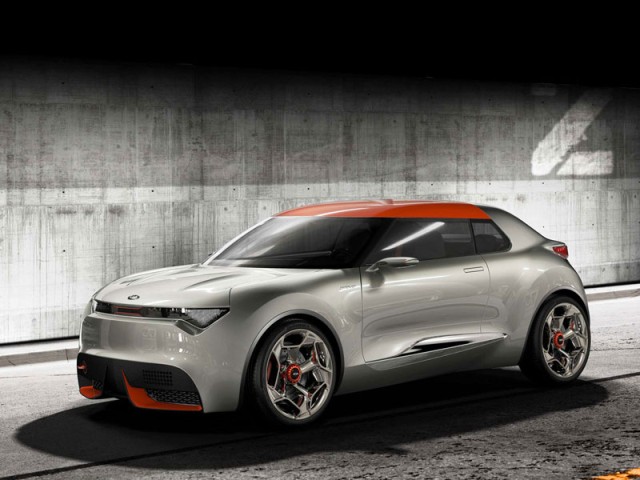
The Korean manufacturer Kia has in recent years renewed its range dramatically. In the future, additional model lines will be added, with the Concept Car "Provo", the Koreans now show a small sports coupe.
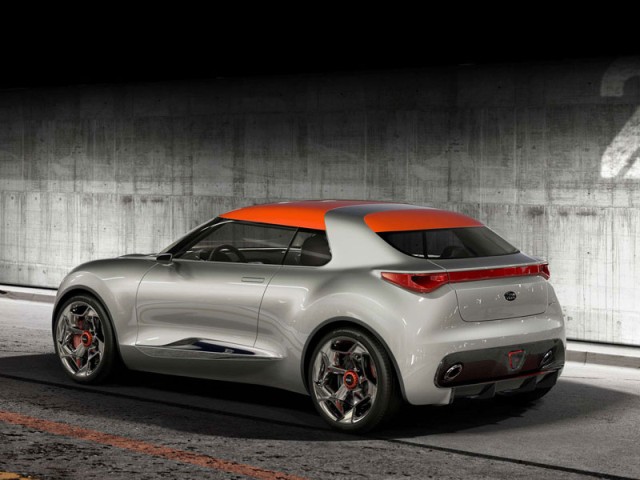
With a length of only 388 cm of Provo is located in the B segment and fully trimmed for sportiness. The design looks like a very beefy, especially the front view has the potential to clear the left lane of the highway freely.
The two-tone paintwork underlines the dynamic character of the little Kia continues. The silver and orange blend it well and give the Provo an outstanding expression.
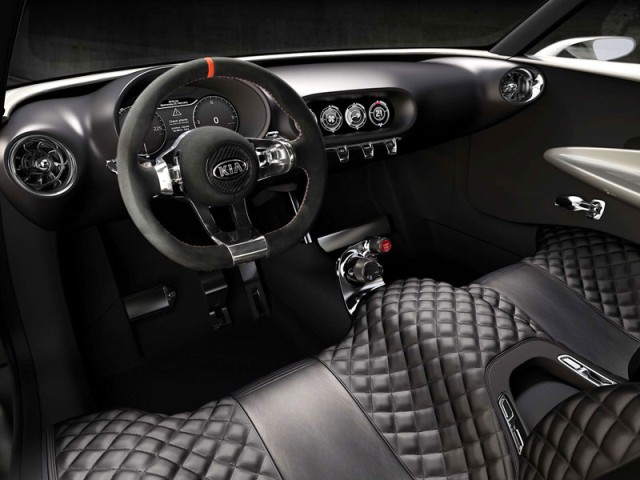
Design is very sporty and the interior, which is equipped with two sports seats and lots of decorative inlays in carbon look. The reduction to the essentials and a handy, small sports steering wheel round out the new design of interior design continues to decrease.
So that little Kia looks not only fast, but it is also, Kia has fitted the Provo with a hybrid drive. A 1.6-liter GDI turbo gasoline engine with 204 hp, assisted by an electric motor whose power is 45 hp.
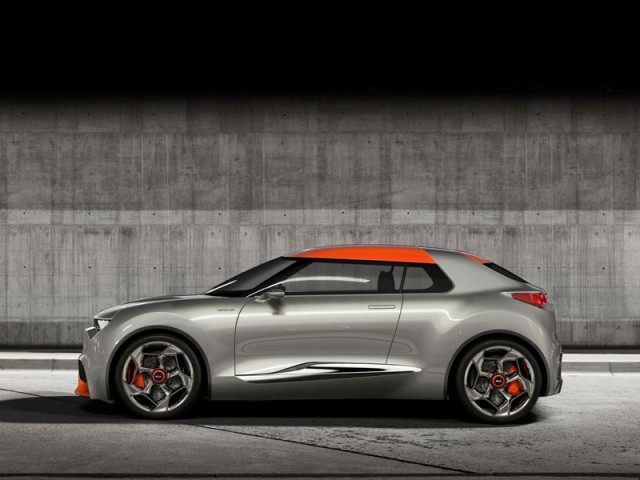
During the gasoline engine drives the front axle, the power of the electric motor is fed to the rear axle. For instance, the Provo a "smart 4WD" drive. At low speeds, the Provo is even purely electric way.
Is first switched on a new dual-clutch transmission with seven speeds, a first for Kia. Although Kia currently precludes mass production of Provo, some elements of which will be sure to find in the next Kia models, especially the new automatic.
Friday, January 17, 2014
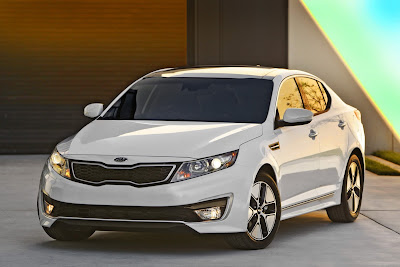
Kia Optima Hybrid Updated for Has Less HP but More Torque
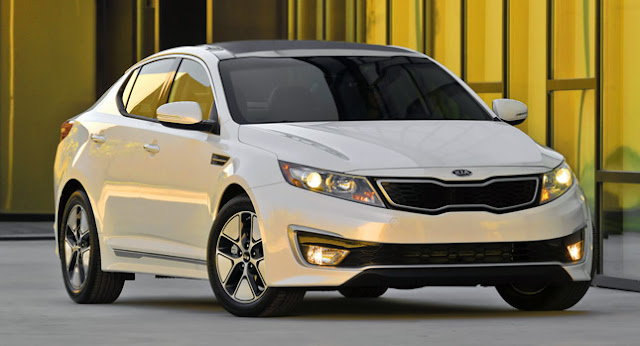
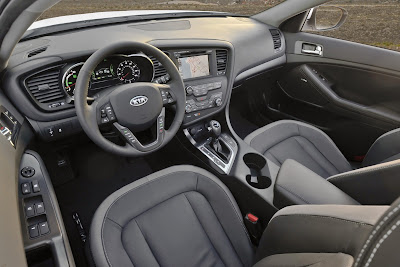
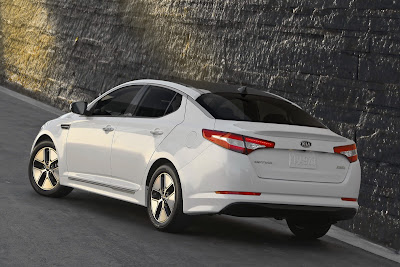
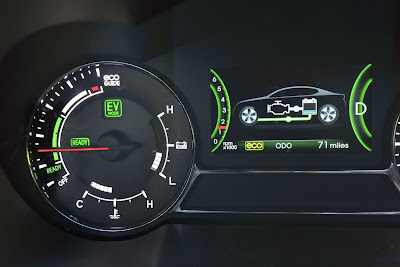
A new set of more aerodynamic rims are also now installed as standard – 16-inch on the base model and 17-inch on the EX. It also rides lower than before, in an effort to reduce drag.
Wednesday, January 15, 2014
2012 Kia Sedona Review Prices

 Upon production,the 2012 Kia Sedona are both trims are equipped with a standard 3.5-liter, V6, 271-horsepower engine that achieves 18-mpg in the city and 25-mpg on the highway. A 6-speed automatic transmission with overdrive is standard. The latest generation of 2012 Kia Sedona packs the kind of convenience and features along with warranty and hence, this 2012 Kia Sedona is more superior that its competitors.
 Although still an excellent, feature-laden minivan, the 2012 Kia Sedona lags behind revamped rivals and begs for the upgrade treatment recently given to other Kia models. If you are looking for comfortable and safe minivan, then this 2012 Kia Sedona is just perfect for your requirement.
Saturday, November 30, 2013
Kia Ceed


- Kia Ceed, 2013
Making its global premiere at the 2012 Geneva International Motor Show is the all-new Kia ceed. More sophisticated, more efficient, more refined and with a more engaging driving experience than its predecessor, new ceed is expected to build on the success of the original model, further establishing Kia as one of the leading automotive brands in Europe.
Launched in 2007, the original ceed was a landmark and game-changing model for Kia. Designed, developed and built in Europe, ceed was the first model to establish Kia as a serious contender to the established brands. Winning praise from media and public alike for its all-round ownership proposition, ceed claimed fourth place in the European Car of the Year Awards that year - the highest ever ranking for a Kia vehicle.
New ceed five-door goes on sale across Europe from the second quarter of 2012, depending on market, and will play a significant role in driving Kias sales in Europe even higher. Further information about other models in the new ceed family - including the SW version displayed at Geneva - will be made available later this year.
Longer, lower and more streamlined
New ceed is both longer and lower than its predecessor, giving the five-door hatchback a more sporty profile. Overall length is increased by 50 mm (to 4,310 mm) and overall height has been reduced by 10 mm (to 1,470 mm) by lowering the ride height. Despite being based on a completely new platform, new ceed carries over the 2,650 mm wheelbase, one of the longest in the C-segment, from its predecessor.
This more athletic appearance is further enhanced by a wider track. While the overall bodyshell is 10 mm narrower, the front and rear track have been increased (by 17 mm and 32 mm, respectively). The impact on the cars aesthetics is heightened by the availability of 17- and 18-inch diameter alloy wheels, resulting in a minimal gap between tyres and bodywork.
The new models sleek silhouette was shaped by extensive testing in the state-of-the-art wind tunnel at Kias R&D centre at Namyang, Korea. A reduced windscreen angle, smooth covers beneath the engine bay and the central floor, a rear spoiler above the tailgate and carefully profiled rear lamp clusters all help new ceed achieve a Cd figure of just 0.30, placing it among the best-in-class, and helping to reduce fuel consumption and cabin noise.
New Kia ceed will be manufactured exclusively at Kias Zilina facility in Slovakia in a range of 10 exterior colours - including five new - and will be among the first models to bear the new-look Kia badge on its bonnet. Simpler, sleeker and with a more modern appearance, the new badge design echoes the premium feel of new ceed and incorporates the Kia script in a single raised section for greater legibility.
Powerful and efficient engines with six-speed transmissions
In developing new ceed, Kias engineers had a strong focus on reducing fuel consumption and emissions without sacrificing engine response or power output. Updated engines and various small but impactful changes have resulted in an average fuel consumption improvement of four per cent across the model range.
Depending on individual market preferences, the new ceed will be available with a wide choice of engines offering power outputs from 90 to 135 ps. Across most of Western Europe there will be two petrol engines - a 1.4 MPI and a 1.6 GDI producing 100 and 135 ps respectively - plus two diesels - a 1.4 WGT with an output of 90 ps and 1.6 VGT diesel offered in two states of tune (110 and 128 ps). Certain markets in Europe will also offer a 1.6 MPI petrol unit producing 130 ps.
Kia anticipates that its top of the range diesel - the highly-efficient 1.6-litre variable geometry turbo unit - will be the most popular choice in most markets. Generating 128 ps and 260 Nm, the engine will be offered with a choice of six-speed manual or automatic transmissions and will accelerate the new ceed to 100 kph in less than 11 seconds. Fuel consumption will be just 4.1 l/100 km on the combined cycle (3.7 l/100 km in cars fitted with Kias EcoDynamics technologies), and CO2 emissions start at just 97 g/km.
The Gamma petrol engines also offer an excellent balance between performance and economy. The most powerful, the 1.6-litre Gamma GDI engine introduced in the Kia Sportage, features direct injection to maximise power (135 ps) and torque (165 Nm) while minimising fuel consumption and emissions. With this engine, new ceed will accelerate to 100 kph in 9.9 seconds while delivering fuel consumption of 5.8 l/100 km (5.2 l/100 km with EcoDynamics), and tailpipe CO2 emissions from 119 g/km.
All engines will be offered with a choice of manual or automatic six-speed transmissions. Depending on version, the 1.6 GDI will also be available with Kias all-new six-speed Dual Clutch Transmission (DCT), which improves fuel efficiency and delivers smooth automatic gear shifts for maximum comfort.
Developed by Kias in-house transmission development team in partnership with a German-based engineering firm, the DCT makes the Korean brand one of a very small number of car makers in the world to produce its own dual-clutch transmission.
The DCT combines two manual transmissions within a single housing, each with its own dry clutch. One transmission shaft is dedicated to 2nd, 4th, 6th and reverse gear, while the other operates with 1st, 3rd and 5th gears.
Working in parallel, one shaft prepares to engage the next ratio, while the other is still engaged with a gear. Electric motor-driven actuators controlled by the Transmission Control Unit (TCU) execute gear selection and clutch engagement, resulting in swift and precise gear changes and uninterrupted torque transfer to the driven wheels, with a minimum of the efficiency loss normally associated with conventional automatics (with a torque converter).
As with other Kia models in Europe, new ceed will be available with fuel-saving technologies developed under the companys EcoDynamics™ sub-brand to optimise efficiency and lower emissions. These technologies, which will be available on both diesel and petrol models with manual transmission, include ISG (Start/Stop), low-rolling resistance tyres and an alternator management system (AMS).
Smoother ride with improved handling, plus variable power steering
Ride and handling for new ceed was benchmarked against class-leading competitor vehicles from near-premium brands.
Fully-independent, subframe-mounted suspension with MacPherson struts at the front and a multi-link set-up at the rear exploit the newcomers wider track to deliver improved handling and road-holding.
The hugely increased torsional rigidity of the new ceed bodyshell (45 per cent stiffer than the original model), has also enabled Kias engineers to introduce numerous small changes to components, springs and shock absorbers that influence ride quality, refinement and NVH.
Improvements to the front suspension include an increased castor angle (from 4.4 to 5.2 degrees) for greater straight-line stability, larger wheel bearings in a reinforced hub, and larger diameter bushes for the subframe attachments. At the rear, geometry changes ensure more accurate tracking, the trailing arms have larger bushes and friction has been reduced throughout the system.
The standard steering system employs electric power-assistance and requires 2.85 turns lock-to-lock for a 10.34-metre turning circle. New ceed is also available, on certain models, with an all-new Flex Steer™ system for improved driving dynamics. This system introduces three operating modes - comfort, normal and sport - allowing the driver to vary the level of steering assistance and the weight of feedback, in order to best suit the current driving conditions and the drivers personal preferences.
Less cabin noise, more cabin space
Kias engineering team was determined to achieve significant improvements over the previous model in terms of cabin refinement and NVH. Measures adopted include fitting 14 per cent thicker front door window glass, low-drag exterior mirror housings, new vibration-damping engine mounts, hollow drive shafts, stronger bodyshell joints between the sills and B-pillars, double-layer door seals, and increased foam-filling in the A-, B- and C-pillars. As a result of these measures, cabin noise levels have been cut to match class-best standards.
Although the 2,650 mm wheelbase is carried over for new ceed, the increase in overall length contributes to more interior space for people and cargo. Front seat occupants have 12 mm more headroom and 21 mm more legroom, while rear passengers gain 5 mm of shoulder room. Cargo capacity is boosted by 12 per cent to 380 litres (up 40 litres) with the rear seats upright and the split-folding rear seats can be made fully flat for maximum versatility.
High-quality equipment and advanced technologies
Higher quality cabin materials and a broader range of high-tech equipment will ensure the interior of new ceed matches the premium exterior appearance.
Primary and secondary controls are grouped in a driver-oriented layout for intuitive ease of use, while new standard equipment will include tilt and telescopic steering wheel adjustment, iPod, Aux and USB support, six speaker audio system and a multi-mode trip computer.
A choice of bright chrome, piano black and anodized metal trim accents will be offered, while indirect LED lighting of the centre console and sweeping vertical fin door handles establish an upmarket ambience for the cabin. The seat and cabin trim will be available in a choice of two colours as standard - black one-tone and stone beige two-tone - in cloth, with a full leather interior available on high specification versions.
The features will include enhanced instrumentation - with a TFT Supervision Cluster delivering high-definition resolution clarity of the instrument binnacle, dual-zone climate control, powered drivers seat adjustment with memory and a full length (1,045 mm long) powered panoramic glass sunroof.
New Kia ceed will be available, depending on version, with LED daytime running lights, fixed cornering lamps (illuminated depending on steering angle), and advanced HID headlamps that turn the low beam to match curves in the road and enhance the drivers night vision.
Parking can be made easier with the new Parallel Park Assist System (PPAS). This features front, side and rear sensors and automatic steering control by an on-board computer to safely perform parallel parking. The driver remains in control of the accelerator and brake.
Safety structure and features target maximum rating
Kia continues to make safety a top priority and the new ceed features advanced active and passive safety technologies to ensure maximum protection for its occupants and other road users. Kia is determined to achieve the maximum rating when tested by EuroNCAP with this new model.
Available active safety features will include ESP (Electronic Stability Program), ABS (anti-lock braking system), BAS (emergency Brake Assist System), HAC (Hill Assist Control) to prevent roll-back, VSM (Vehicle Stability Management) and ESS (Emergency Stop Signal) which flashes the brake lights when the system detects that the driver is making an emergency stop.
In terms of passive safety, the bodyshell is constructed using a high percentage (57 per cent) of ultra high-tensile steel and features numerous improvements to enhance impact resistance. New transverse cross-members are fitted to link the front and rear suspension mounts, new pressings link the rear trunk floor to the tailgate opening and the rear roof rail is connected to the C-pillars and a new floor cross-member to create an extremely strong safety ring.
Side impact protection is enhanced with 50 per cent thicker door beams, plus a stronger roof cross-member between the B-pillars and side sills made from ultra high-tensile steel.
Each new ceed is fitted with six airbags as standard - front, front side and full length curtain. Pedestrian safety is improved with the adoption of collapsible headlamps, a stiffer lower bumper lip, and shock-absorbing structures in the hood and its hinges.
Tuesday, October 1, 2013
2012 Kia Forte 5 door Review And Prices
 The 2012 Kia Forte 5-door is one of the latest version of 2012 Kia. A 2012 Kia Forte 5-door is a 4-door, 5-passenger family sedan, available in two trims, the 2012 Kia Forte 5-door and the 2012 Kia Forte 5-door SX. the 2012 Kia Forte 5-door is available at price of $18,100 - $19,600 And invoice price of $17,240 - $18,670.
 Upon introduction, the 2012 Kia Forte 5-door EX is equipped with a standard 2.0-liter, I4, 156-horsepower engine that achieves 25-mpg in the city and 34-mpg on the highway. The 2012 Kia Forte 5-door SX is equipped with a standard 2.4-liter, I4, 173-horsepower engine. A 6-speed manual transmission with overdrive is standard on both trims, and a 6-speed automatic transmission with overdrive is optional.
  The all-new Forte 5-door, as Kia calls it, is the hatchback nameplate-mate to the Forte sedan that was first introduced in 2009. The Forte 5-door is intended to expand the Forte lineup with a more versatile option a hatchback. A 2012 Kia Forte 5-door offers an impressive array of standard safety equipment, including: front active headrests, dual advanced front airbags, front seat-mounted and side curtain airbags, full-length side curtain airbags, side impact door beams, front and rear crumple zones, four-wheel disc brakes with an Antilock Brake System (ABS), Electronic Brake-force Distribution (EBD) and a Brake Assist System (BAS), Electronic Stability Control (ESC), a Traction Control System (TCS) and a Tire Pressure Monitoring System (TPMS).
Friday, September 27, 2013
Kia Cadenza K7 2013 Luxury In An Intensified Form

Inspiring Kia Cadenza (K7) 2013


Kia Cadenza (K7) 2013 News 

Kia Cadenza (K7) 2013: Luxury In An Intensified Form
Thursday, September 12, 2013
Kia Sorento 2012 Do Not Ignore
Kia Sorento 2012Â has the wind in its sails. The Korean brand products show a constantly improving quality, reliability an upward trend and style of the body is positively successful. Moreover, they are in the air. Furthermore, vehicles that do not sell are shown the door pretty quickly. This year, for example, the Borrego, a very good SUV hardcore, but arrived on the market a few years too late, is no longer in the game. Now the largest vehicle Kia Sorento 2012Â is.
The Kia Sorento 2012Â has been completely redesigned in 2010 for the 2011 model year. The previous generation was traveling on a truck chassis (such as the Borrego), but during the redesign, engineers have preferred a monocoque platform.
A good option Kia Sorento 2012
Both engines are available to the consumer. Already, after only a year, the four-cylinder 2.4-liter direct injection wins. In fact, it is the same engine as the Optima. Although official figures have not yet been disclosed at the time of going to press, we can assume that its power will be substantially the same as in the sedan (200 hp and 186 lb-ft of torque). The previous version had 175 hp and 169 lb-ft of torque. Since the vehicle weighs nearly 1,800 pounds, 25 hp and 17 lb-ft of torque, even if they come earlier in the towers, will certainly welcome. In This Kia Sorento 2012Â new engine will be associated to the six-speed automatic transmission.
Without a doubt, the 3.5-liter V6 is the perfect choice. Much more powerful, it allows playful performance. Of course, it consumes more. This engine is flexible and dovetails well as six-speed automatic. The basic version can get traction, but even if we were unable to test this variant, it is likely that the effect of torque is very present in the wheels during acceleration ups.
Even though theKia Sorento 2012 has more “legs” to follow a 2010 in a very muddy field, it still offers all-wheel drive with locking center differential is. No doubt this system will satisfy 98% of users, while being much more modern than the 4×4 which it replaces.
In terms of driving, behaves like the Kia Sorento 2012Â mid-size SUV that is: large, not very sporty, but comfortable. The suspensions are a little too firm for some tastes, but it gives the feeling of driving solid. Another advantage: the firm suspension limits body roll when cornering. Management appeared to me a bit too light for my taste, but its accuracy was correct.
The Kia Sorento 2012, besides its contemporary style that respects the Kia brand, guarantees the most interesting. For many, this argument simply down to sign the contract. Wish them to have enough money to buy the V6!
Kia Sorento 2012 on FaceBook
Kia Sorento 2012: Do Not Ignore
Saturday, May 8, 2010
KIA pop electric car concept

Kia hasn't released any details or technical