Showing posts with label Concept. Show all posts
Showing posts with label Concept. Show all posts
Wednesday, March 19, 2014
Acura MDX Concept


- Acura MDX Concept, 2013
The 2014 Acura MDX Prototype made its world debut at the 2013 North American International Auto Show, offering a strong indication of the styling and design direction for the third generation of the popular, 7-passenger Acura MDX performance luxury SUV, launching by mid-2013 in both all-wheel-drive and front-wheel-drive layouts.
"Our goal is to advance on MDXs already great dynamic performance while improving fuel economy and luxury comfort," said Mike Accavitti, vice president of national marketing operations. "Building on the great momentum we established in 2012 with the launch this year of our flagship RLX, followed later this year by a terrific new luxury SUV in MDX we are very excited about the direction of the Acura brand. And we are truly looking forward to a great 2013."
The "Aero Sculpture" styling of the 2014 MDX Prototype pursues the direction of a smart, compact and premium appearance with low, wide and sleek proportions; a clean, efficient and uncluttered design; and elegant, premium detailing, including the signature Acura Jewel Eye™ LED headlights. This "aero" image also lects significant gains in aerodynamic efficiency, up 16 percent compared to the outgoing 2013 MDX, achieved through extensive testing in Honda R&D Americas new wind-tunnel laboratory in Raymond, Ohio - where the vehicle is being created.
The 2014 MDX Prototypes sculpted exterior and arcing roof line (1.5-inches lower than the outgoing model) encase what will be an even more spacious and versatile cabin compared to the outgoing 2013 MDX. The 2014 MDX Prototype features a longer wheelbase that enhances ride quality, increases second-row legroom, and improves third-row seat access.
In response to strong demand from consumers in warm weather markets Acura also will, for the first time, offer a front-wheel drive version of MDX in addition to the all-wheel drive (SH-AWD) model that has earned MDX a reputation as a leader in dynamic handling and all-weather performance for a luxury SUV.
The 2014 MDX will also feature an all-new, more rigid and lightweight chassis, including new front and rear suspension designs that deliver a more ined, confidence-inspiring, and sporty driving character. An all-new, direct-injected 3.5-liter i-VTEC SOHC V-6 engine with Variable Cylinder Management (VCM) will deliver improved torque and more spirited performance while realizing a significant increase in fuel efficiency to class-leading levels. Special attention was also paid to improving cabin quietness, which is greatly enhanced by the vehicles all-new chassis and body design and new sound-deadening techniques.
The 2014 MDX also will be equipped with a broad array of advanced safety technologies, including the next generation Advanced Compatibility Engineering (ACE) body structure and the available Forward Collision Warning (FCW) and Lane Departure Warning (LDW) systems, as well as visibility technologies such as the Multi-Angle Rearview Camera and the available Blind Spot Information (BSI), Lane Keeping Assist System (LKAS), and Active Cruise Control (ACC) with Low-Speed Follow. Further, the 2014 MDX is designed to achieve top-level safety ratings, including a 5-star Overall Vehicle Score from the NHTSA and a TOP SAFETY PICK+ rating from the IIHS. All 2013 Acura models other than the outgoing ZDX achieved at least a TOP SAFETY PICK safety rating, while the TL sedan was one of the first two vehicles in the industry to achieve TOP SAFETY Pick+ status.
The new MDX also feature a full array of advanced information technologies, including the next-generation AcuraLink cloud-based connected car system featuring Pandora connectivity, SiriusXM radio, SMS text messaging, and cloud-based Aha by Harman connectivity that brings thousands of personalized news, information and media feeds into the vehicle via the customers compatible smartphone and data plan. A premium Acura/ELS audio system will be available on the new MDX. Next-generation Acura Link will also be available with a host of fee-based convenience, assistive and security features, such as automated crash notification, remote locking/unlocking, emergency "SOS" call feature, and live-operator concierge services.
With the introduction of the all-new 2014 Acura MDX production will move from Alliston, Ontario, to the companys vehicle and V-6 engine manufacturing facility in Lincoln, Alabama. Using domestic and globally sourced parts, the MDX is built exclusively in North America.

Friday, March 7, 2014
Alfa Romeo 2uettottanta Concept Review

To mark the 80th anniversary of her, Pininfarina offers "open" Alfa Romeo 2uettottanta concept is interesting and fun to drive. For those who like to dream in the car. For those looking for a mixture of pride, entertainment and enjoyment of outdoor living. For those who love icons as the greatest expression of the age we live for those who want their car to be an unusual sensory experience in terms of both style and behavior, without obsessed with performance. For those who want to be excited by a dynamic sports car that conveys exclusivity and repair typical Alfa Romeo spider designed by Pininfarina.
2uettottanta: a name that evokes the legendary duo, but also years of Pininfarina, who launched the celebration of his 80th birthday with this concept car. And decided to do with the type of car that, by definition, the work of Pininfarina: an Alfa Romeo Spider. A product that is very Italian, who became registered exports, which represent an inexhaustible talent that combines the world with Italy.
Alfa Romeo Pininfarina Concept 2uettottanta lects a determination to look ahead with optimism following tradition, reaffirming excellence in design and innovation capacity acknowledged aesthetics and technology. This concept is an innovative approach, projected into the third millennium, a subject that is deeply rooted in the history of Pininfarina, Spider two-seater. And like the best Alfa Romeo sports cars come from Pininfarina pens, Alfa Romeos concept glorified 2uettottanta driving experience and focuses on the excitement behind the wheel of the car open with a great aesthetic personality. This is a car that can make people dream and excites even after many years. Icon of a lifestyle that dates back to time, tumultuous life. As a duet of the Sixties, which helped shape the trends that are based on the theme of rebellion and escape, thanks to the movie "The Graduate".

Alfa Romeo concept 2uettottanta also a tribute to Alfa Romeo, which celebrates its centenary in 2010: the alliance between Alfa Romeo and Pininfarina is one of the most significant and enduring in the history of the car, one of the men from the passion design solutions, and advanced technology, which produces a number of precious-looking, innovative cars with a great temperament. With the tendency for a sports car and convertible cars. The goal is to reproduce this with the concept Alfa Romeo 2uettottanta. So the line, clean elegant chosen for this "simple two places," which comes with a 1750 cc turbo longitudinal position, a clear erence to the "Veloce 1750" in 1968, one of the many versions derived from the famous in osso Seppia "(cuttlefish) . With a red body, inspired by classical paintings Alfa Romeo, which 2uettottanta is 1797 mm wide, 4212.6 mm, 1280 mm high and has a wheelbase of 2500 mm.
Driving pleasure and feeling in harmony with nature turned into a inery light, elegant, and shapes that seem to slip through the air more easily. This produces the theme of this concept: the expression of a single volume, a few streets from the ground and suspended. Alfa Romeo Concept 2uettottanta seems almost lifted off the ground "more distant". This is an optical effect is achieved with a horizontal line around the car. A continuous sign applied to dynamic, sporty proportions - typical of Alfa Romeo spider - emphasized by the configuration of the cabin, which is significantly shifted to the rear. Design strength lies in its exaltation of simplicity, which does not need to flex its muscles, but only focuses on agility and harmony.
The front 2uettottanta Alfa Romeo concept Alfa Romeo says true character. The design is simple, with a central line that works well on the cars nose, while the performance of more sophisticated surface. At the center, in full view, and all, but purely decorative element, Alfa Romeo is a shield, which seems to arise from the heart of the car and stretch out into the future Pininfarina, three-dimensional approach. Shield made of aluminum and incorporates a floating horizontal flaps. On both sides of a triangle is two-sided ventilation. Two elements impressed on the hood to create a natural link between the logo and the impressive large windshield, which was designed as a ring in hand-beaten aluminum body that emerged from the car without disturbing the flow. Lights, which adopt the latest LED technology is integrated below the line that gives the car a whole character. A strip of carbon in the bottom of the facade acts as a separator of air, channeling air to the rear of the car.
Car side view, where the theme is repeated in a single volume, emphasizing the fluid lines of the whole, with the incorporation of natural form. Line "cut" horizontally to the side to give a sense of great dynamism, he started from the front and back wheels to the rear wheels. As an athlete, to a car, be thin, but also the production of aerodynamic efficiency. Pininfarina has always fought for the natural forms that can convey the effectiveness and respect for the environment, the approach is confirmed by a strong commitment to the theme of eco-sustainable mobility. Alfa Romeo Concept 2uettottanta is in perfect harmony with nature, a formal expression of a response to the needs of our times: it is the arrow that flies in the wind almost without resistance.
Subtle, important, delicate surfaces, even in the back, which echoes the front, but with slightly more emphasis on the muscles. The design combines stylish simplicity with strong characters in the volume and proportion, with details designed to highlight the dynamic car, light personality. Both the lump seems to arise from the volume, into wings floating in a circle in the back seat. At each end, these bars generate an attachment designed to hold a seat belt. Even the rear light clusters are embedded in a thin line that defines the whole piece.

Much attention has gone into the interior design. The result is interior, roomy comfortable, designed with a light, dynamic volumes, which envelop the occupants in the strong arms of convincing. Shapes are sewn into the leather, incorporating touch controls: in the office, Alfa Romeo 2uettottanta faithful to his calling as a concept car designed to treat to drive. Dashboard extends the fluid on the side to blend with the door as a natural continuation of the volume of cars, creating a perfect symbiosis between the exterior and interior. Dashboard features driver-oriented configuration with an innovative approach to the conventional circular Alfa Romeo "tubes" that contain instruments. The tunnel contains the Alfa DNA selector lever in an ergonomic position, which varies the set-up of the car in three modes, Dynamic, Normal and All Weather, adapting the behavior of various vehicle systems (engine, transmission, suspension, steering, brakes, etc.) requirements and drivers different driving conditions. Tunnel through the interior and provide a frame structure, revealing the carbon elements: the choice of material lects Pininfarina constant search for alternative materials that can make vehicles lighter, reducing fuel consumption and emissions. Another powerful element of the interior is the steering wheel, which is a modern interpretation of the three perforated shelves duet, with the addition of paddle shift control for sequential gearbox with double clutch. A pleasant and comfortable drive is guaranteed by the anatomy of a sports site. Everything in the car "floats" ventilation ducts are placed between the cockpit and hull.
The size and design of the tire, which was created specially for the Alfa Romeo 2uettottanta concept in collaboration with Dunlop, accentuating the impression of strong character and strength provided by the car. Tires are low-profile type, right at the extreme edge of the plan view: designed by Pininfarina to incorporate innovative technologies developed by Dunlop, their graphics lect off the car. Their aerodynamic shape and very smooth lateral profile, ensure better handling and less air resistance, thus reducing consumption. Aluminum wheels are treated in line with the rest of the car, and is a free interpretation of the classic Alfa Romeo five circles, revealing a high performance carbo-ceramic Brembo brakes Alfa Romeo.
Alfa Romeo Concept 2uettottanta is not an exercise in pure style, but also a project and research: the goal is to capture the spirit of the spider in the configuration, proportion and design of the car and in his style traces. Working method is one of the genes of Pininfarina. For this project, the creative team at Pininfarina gives carte blanche to express the values inherent in the Alfa Spider "by Pininfarina", the values are considered to have a Giulietta Spider duet or all time classics. To achieve this, the car was given a special introduction, with a low center of gravity and the interior is very open so it does not isolate the residents of the surrounding environment. The result is to bring the road "closer" to the eyes of the driver and increase the sense of dynamism even at low speeds.
What effect 2uettottanta? The desire. Anyone who saw it "should" have it, to drive it, enjoy it. Because 2uettottanta not a dream. Nor does 2uettottanta not want to impress at first, but to achieve a beauty that is not trying just to confirm immediately, but gradually reveals all values and transfers them in the future, making an eternal style. As he did in the case of a duet, which continues to be celebrated as an icon of design after 40 years.
Monday, March 3, 2014
Saab 9 3 ePower Concept 2010


- Saab 9-3 ePower Concept, 2010
The Saab Automobile is taking its first step towards developing an all-electric vehicle with the Saab 9-3 ePower. Making its public debut at the 2010 Paris Motor Show, the Saab 9-3 ePower is the prototype for a test fleet of 70 vehicles which will participate in extensive field trials in Sweden in early 2010.
The performance of the cars will be evaluated under a variety of real world driving conditions as part of the development process for a purpose-built, electric Saab vehicle. Targets to be verified include a projected driving range of approximately 200 kilometers through the use of high density energy storage in lithium-ion battery cells.
The Saab ePower is the first electric vehicle from Saab and is a result of a co-operation between Saab Automobile, Boston Power (batteries), Electroengine in Sweden AB (electric power trains), Innovatum (project management) and Power Circle (Swedens electric power industry trade organization).
Mid-sized sports combi with zero emissions
The Saab 9-3 ePower is the first all-electric car to offer its occupants the comfort and size of a wagon bodystyle. Saab engineers have integrated an electrical architecture within the shape and dimensions of a conventional Saab 9-3 SportCombi.
Under the hood is a 135 kW/184 hp electric motor driving the front wheels through a single-speed transmission. Instant torque enables zero to 100 km/h acceleration is just 8.5 seconds, together with a top speed of 150 km/h.
The compact yet powerful 35.5 kWh lithium-ion battery pack is accommodated in a modified floor-pan, mainly in space within the cars wheelbase previously occupied by the exhaust system and fuel tank. This enables an optimum weight distribution and excellent driving dynamics similar to those of a standard SportCombi.
Inside the cabin, a conventional, automatic-style gearshift lever provides selection of drive, neutral, park and reverse. The rev-counter, fuel and turbo boost displays in the main instrument cluster are replaced by read-outs for battery status, power consumption and driving range, all illuminated in green. To optimize space, an electric park brake is fitted.
Electro-hydraulic power steering is used and the cabin is equipped with full air conditioning, via a compressor powered by the battery pack. A separate 12-volt battery, for the lights and cabin ancillaries, is also charged from the battery pack via a current transformer
The operation of the vehicles powertrain is controlled by a version of Saabs own in-house Trionic 8 engine management system, with new software written for an electric vehicle application.
Long driving range with excellent durability
The Saab 9-3 ePowers projected driving range of approximately 200 kilometers pushes out the boundaries for current EV performance. Key to its long range are battery cells which have an energy storage density substantially greater than the best currently used in EV applications. High energy density also contributes to a lower battery weight.
The battery pack has a capacity of 35.5 kW/h and is designed to operate with full power in ambient temperatures as low as -30ºC, at least 10ºC below the operating level of other battery packs on the market today. Another key benefit is the use of air, instead of liquid, cooling which contributes to lower cost and further weight-saving in the packs design.
The pack is intended to support re-charge cycles equivalent to about ten years average use. It can be fully recharged from a domestic mains supply in about three to six hours, depending on depletion status. Charging times can be greatly reduced if the voltage of the electrical feed is raised, as there is no limitation on the batterys input capacity.
Test driving experience is expected to validate the performance of this advanced battery pack, which is designed to operate reliably within a full depletion buffer set at only 12 percent of total capacity, a much lower operating margin than used in the management of other packs.
Its lithium-ion battery cells are also the first to receive a Nordic Ecolabel accreditation for their environmental safety and sustainability, which includes manufacturing processes.
The Saab 9-3 ePower meets the high crash worthiness standards that Saab applies to all its vehicles. The cars power pack is located outside the occupant compartment in non-deformable structural zones, well protected and encapsulated. The battery management and monitoring system supports safe performance during normal driving and in crash conditions.
Extensive user trials
Hundreds of drivers and their families be enlisted by Saab and its development partners during a extensive test driving and evaluation program involving a 70-strong fleet of Saab 9-3 ePowers in central, west and eastern Sweden during 2011-12.
The Saab ePower project team in Trollhättan monitor the performance of the cars across a wide variety of usage patterns and driving conditions. To log essential component data, all vehicles will be equipped with aircraft-style, black box recorders.
Sunday, March 2, 2014
De Tomaso Deauville Concept 2011


- De Tomaso Deauville Concept, 2011
Pininfarina welcomes the De Tomaso Deauville styling model on its stand at Geneva. For the glorious brand founded in Modena in 1959 by Argentine racing driver Alejandro De Tomaso, which has been brought back to life thanks to efforts of businessman Gian Mario Rossignolo, Pininfarina has designed a 5-door Sport Luxury Sedan, with an aluminium chassis and four-wheel drive. A complete product that embodies high technology and craftsmanship, combining luxury and love for engines with a decisive modern approach to design.
The project was launched at the end of 2009, when Pininfarina S.p.A. drew up with De Tomaso Automobili SpA (formerly Innovation Auto Industry S.p.A. - IAI) a company chaired by Gian Mario Rossignolo, the definitive agreement for the sale of a branch of the company that included the manufacturing plant of Grugliasco (Turin). The two companies also agreed that the first model to be produced by the reborn De Tomaso company would be designed by Pininfarina.
From the very first stages of the design process, De Tomaso and the Pininfarina design team set themselves the target of exploring new territory and creating a new market niche, developing a Sport Luxury Sedan for an exclusive clientele, designed and developed with the utmost luxury.
Luxury is not a coincidence: the development of the De Tomaso Deauville hinges on exploiting the concept of quality products that are "Made in Italy", reviving and ining in the present the characteristics of beauty and craftsmanship that are inherent in the Italian manufacturing heritage. All the cars are "custom-built" and the assembly of the details is guaranteed by the manual skills of De Tomaso specialist craftsmen. Each De Tomaso Deauville is theore unique and self-sufficient.
But the luxury is not only embodied in the artisan construction. In addition to the Pininfarina design, the car also boasts a high technological content that puts it ahead of its time. The De Tomaso Deauville is manufactured using the innovative UNIVIS technology, which means that the bodyshell is assembled using aluminium extruded sections joined together by crossbeams that are pressed, trimmed by laser and welded. This new technology, developed and patented by IAI (Innovation in Auto Industry), the parent company of the De Tomaso group, makes it possible to drastically reduce the times and investment necessary to design a car, because the number of dies is drastically reduced to a few dozen.
The Pininfarina team tackled the design of the De Tomaso Deauville by first carrying out a historical analysis of the De Tomaso brand, and focusing on the stylistic elements that have characterised earlier models like the Mangusta or the Pantera. The challenge was to imagine a completely new type of car without distorting such an important heritage, but also to firmly avoid turning it into an exercise in nostalgia.
The result is a car that has no equal in todays car market. A sporty, seductive saloon of a considerable size (height 1630 mm, length 5080 mm, width 1950 mm), with clean, elegant lines, a decisive and immediately recognisable character and a sporty feel that is lected on the motorist as a pleasant driving experience, while guaranteeing performance, safety, roominess, maximum comfort and all the options one would expect on a luxury saloon.
The resolution of the front is expressed by the personality of the large hexagonal grille that urges forward, transmitting assertiveness and sportiness, and lecting the cars potential for performance, while the front light clusters, which slip towards the sides of the car, underline its dynamism. The hexagon, which harks back to motifs dear to De Tomaso history, is repeated on the side of the car (air outlet, front wing and shape of windows) and in the design of the rear light clusters. Another leitmotif runs through the car: the three upper wings of the grille, which are reiterated in the direction indicator on the front headlight and continue in the side repeater and the rear light.
Wednesday, February 19, 2014
Audi Q3 Concept
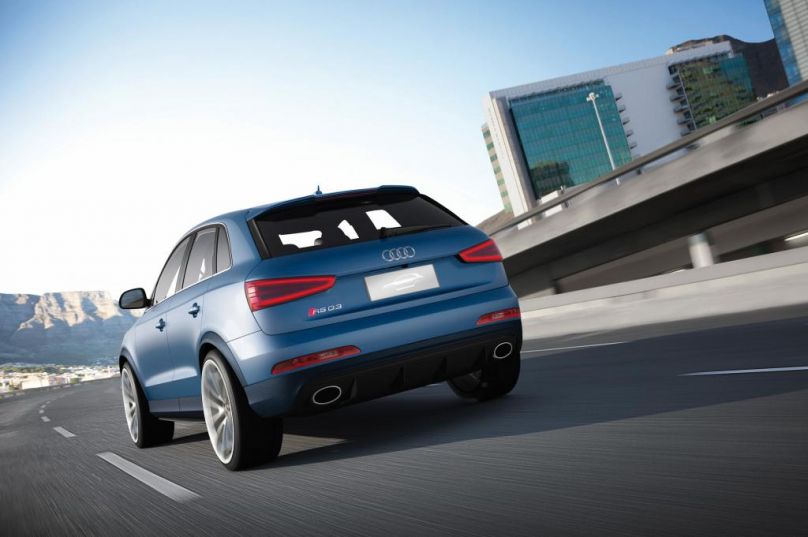
Auto China Motor Show 2012 in Beijing Audi RS presents a concept car based on the concept Q3. This is a unique interpretation of the nature of the compact SUV - consistently dynamic.
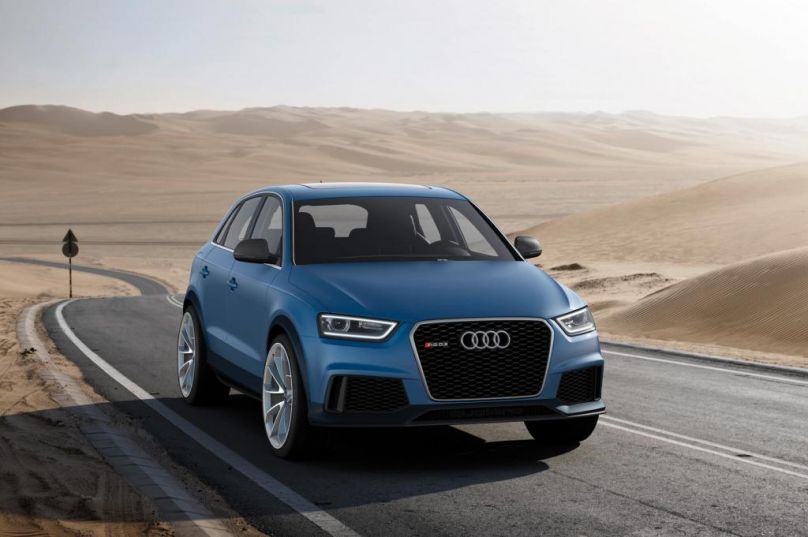
Painted in blue Audi RS Q3 concept car is a thrilling dynamics. MOTOR 2.5 TFSI generating a power output of 265 kW (360 hp) and extended and lowered by about 25 mm body, combined with expressive detail that redefines the potential of Q3.
Frame made of brushed and polished aluminum grille is surrounded by a "single-" RS Audi Q3 concept. Black grille guards are placed in a new geometric pattern - honeycombs have been moved slightly to the inside relative to each other, you, that seem to be three dimensional. At the bottom of the grill is visible plastic, silver emblem quattro. Reflectors are slightly tinted. Some chromed elements in them are dark or covered with plastic parts with carbon fiber reinforced plastic (CFRP).
The bumper has been redesigned. His powerful surround the outer edges of the air intakes, which are divided into two segments.
Their internal parts of the grid are honeycomb, exterior, however, are made of plastic reinforced with carbon fiber (CFRP), are in the form of smooth funnels. The front spoiler is also made of CFRP. Its bottom is black and matte, while the lower bumper has been painted blue and covered with clear varnish.
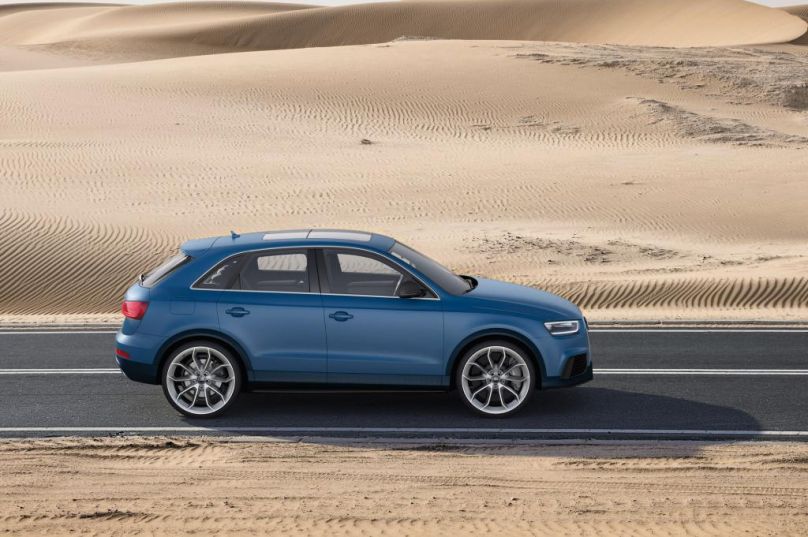
The same combination of black and blue themes can be found on the sides of the RS Audi Q3 concept. This applies to both the strips on the door, and thresholds and caps on the wheel arches. The exterior mirrors are made of black carbon fiber reinforced plastic (CFRP), matt aluminum surround strip side windows. Spoiler drops towards the rear, the middle part is slightly narrower in relation to the exterior. Varnished it in the body color - blue Ordos, the dull blue with a small admixture of yellow.
In the rear of the vehicle, the bottom of the bumper has a sporty, angular shape. Diffuser insert connecting two large, elliptical exhaust tailpipes in typical RS design, it is far over the top. Here too the Audi designers have decided to call CFK in black and matte blue. Rear lights and additional lights placed in the bumper have been dimmed in anthracite color. They are made of clear glass.
INTERIOR
The interior of the Audi RS Q3 concept, which enters through the glass roof is much light, dominated by the cold blackness, which is best seen in the headliner, carpets, rugs, leather lined dashboard and a substantial part leather upholstery Feinnappa. As a contrasting element, used to cover dark blue Alcantara seats.
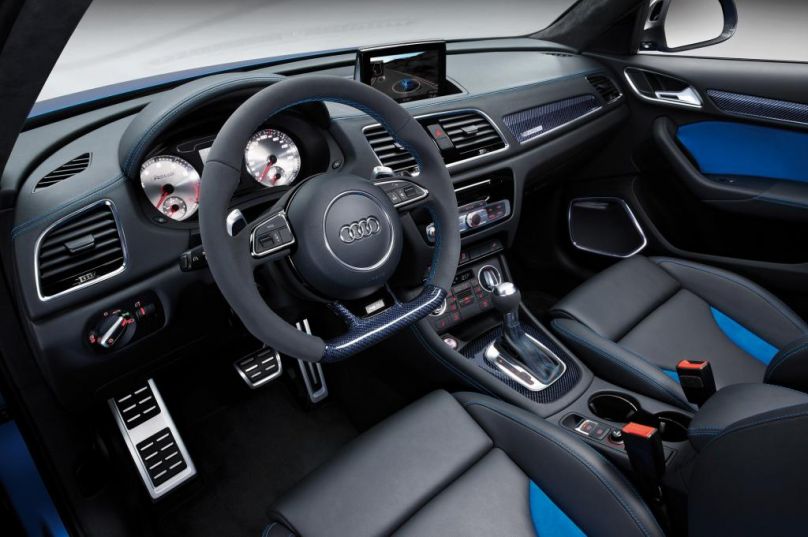
Contrasting blue color was also used - in a rather unusual way - in the patterns made of CFRP. The material is woven into shiny blue glass fibers. On the sides of the steering wheel can be found made of CFRP paddle shifters, which surrounds the edges of the aluminum strip. The greater part of the steering wheel is covered with black leather Velvet. It provides a secure grip hands, preventing the deposition of dirt at the same time. Door trim is made largely of blue Alcantara.
Internal door handles made of lightweight materials, look similar to those installed in other models of RS. Replace the Chinese characters commonly used Arabic numerals rev. Q3 RS emblems adorn the instrument panel, Sitze, sills and floor mats.
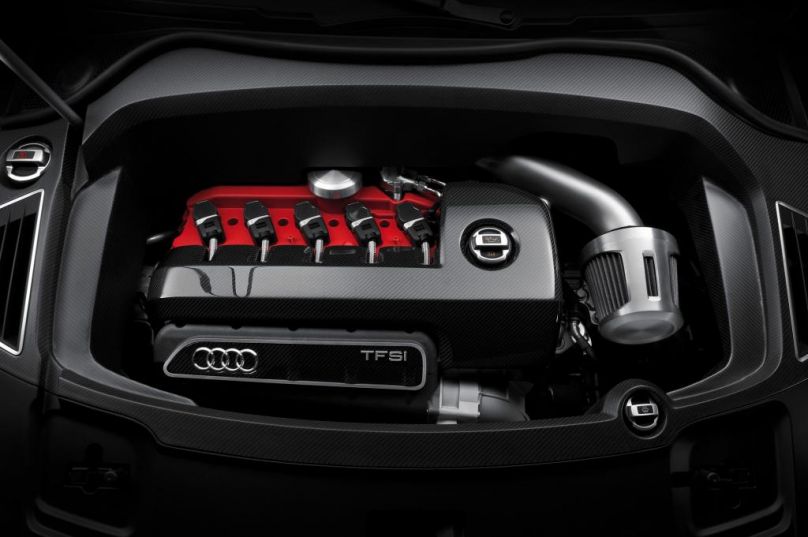
Also the engine compartment has become a very sporty character. Panels with laminated carbon fiber covers the area around the five-cylinder engine with heads polakierowanymi red. The air goes into the engine by the two sides mounted vents. The covers of each cylinder spark plug was placed numbers - just as is done in the world of motorsports. Outdoor sports air filter has an aluminum housing and air intake is made of stainless steel.
ENGINES
A powerful 2.5 TFSI engine in the RS model Q3 concept combines two classic Audi technologies: direct gasoline injection and turbocharging. AUS 2480 cm3 capacity, erzeugt Strom 265 kW (360 hp). Car needs 5.2 seconds to accelerate from 0 An 100 km / h
The seven-speed S tronic gearbox transmits power resonant 2.5 TFSI engine for the permanent all-wheel drive quattro. Under normal traffic conditions, it shall er almost exclusively to the front wheels.
 Alloy wheels Audi RS Q3 concept, size 8.5 J x 20, underline the dynamic design of the RS Q. Its front part was polished to a high gloss, while the edges are sanded.
ContinueReading[...]
Painted in blue Audi RS Q3 concept car is a thrilling dynamics. MOTOR 2.5 TFSI generating a power output of 265 kW (360 hp) and extended and lowered by about 25 mm body, combined with expressive detail that redefines the potential of Q3.
Frame made of brushed and polished aluminum grille is surrounded by a "single-" RS Audi Q3 concept. Black grille guards are placed in a new geometric pattern - honeycombs have been moved slightly to the inside relative to each other, you, that seem to be three dimensional. At the bottom of the grill is visible plastic, silver emblem quattro. Reflectors are slightly tinted. Some chromed elements in them are dark or covered with plastic parts with carbon fiber reinforced plastic (CFRP).
The bumper has been redesigned. His powerful surround the outer edges of the air intakes, which are divided into two segments.
Their internal parts of the grid are honeycomb, exterior, however, are made of plastic reinforced with carbon fiber (CFRP), are in the form of smooth funnels. The front spoiler is also made of CFRP. Its bottom is black and matte, while the lower bumper has been painted blue and covered with clear varnish.
The same combination of black and blue themes can be found on the sides of the RS Audi Q3 concept. This applies to both the strips on the door, and thresholds and caps on the wheel arches. The exterior mirrors are made of black carbon fiber reinforced plastic (CFRP), matt aluminum surround strip side windows. Spoiler drops towards the rear, the middle part is slightly narrower in relation to the exterior. Varnished it in the body color - blue Ordos, the dull blue with a small admixture of yellow.
In the rear of the vehicle, the bottom of the bumper has a sporty, angular shape. Diffuser insert connecting two large, elliptical exhaust tailpipes in typical RS design, it is far over the top. Here too the Audi designers have decided to call CFK in black and matte blue. Rear lights and additional lights placed in the bumper have been dimmed in anthracite color. They are made of clear glass.
INTERIOR
The interior of the Audi RS Q3 concept, which enters through the glass roof is much light, dominated by the cold blackness, which is best seen in the headliner, carpets, rugs, leather lined dashboard and a substantial part leather upholstery Feinnappa. As a contrasting element, used to cover dark blue Alcantara seats.
Contrasting blue color was also used - in a rather unusual way - in the patterns made of CFRP. The material is woven into shiny blue glass fibers. On the sides of the steering wheel can be found made of CFRP paddle shifters, which surrounds the edges of the aluminum strip. The greater part of the steering wheel is covered with black leather Velvet. It provides a secure grip hands, preventing the deposition of dirt at the same time. Door trim is made largely of blue Alcantara.
Internal door handles made of lightweight materials, look similar to those installed in other models of RS. Replace the Chinese characters commonly used Arabic numerals rev. Q3 RS emblems adorn the instrument panel, Sitze, sills and floor mats.
Also the engine compartment has become a very sporty character. Panels with laminated carbon fiber covers the area around the five-cylinder engine with heads polakierowanymi red. The air goes into the engine by the two sides mounted vents. The covers of each cylinder spark plug was placed numbers - just as is done in the world of motorsports. Outdoor sports air filter has an aluminum housing and air intake is made of stainless steel.
ENGINES
A powerful 2.5 TFSI engine in the RS model Q3 concept combines two classic Audi technologies: direct gasoline injection and turbocharging. AUS 2480 cm3 capacity, erzeugt Strom 265 kW (360 hp). Car needs 5.2 seconds to accelerate from 0 An 100 km / h
The seven-speed S tronic gearbox transmits power resonant 2.5 TFSI engine for the permanent all-wheel drive quattro. Under normal traffic conditions, it shall er almost exclusively to the front wheels.
Wednesday, February 12, 2014
Saab PhoeniX Concept 2011


Saab PhoeniX Concept, 2011
Sleek, innovative and exceptionally efficient: the Saab PhoeniX Concept car showcases design features and technologies which will shape the next generation of cars from Saab.
Based on an new architecture which will empower the next Saab 9-3 model, the Saab PhoeniX Concept introduces aeromotional design: a visual evocation of the aerodynamic design principles and passion for innovation that inspired the creators of Saabs first car, the iconic Ursaab.
The Saab PhoeniX Concept embraces teardrop, liquid metal forms and a dramatic jet canopy-inspired glasshouse that gives fresh expression to Saabs signature wraparound and translucent ice-block design themes.
The clean, muscular shape enables an exceptionally low drag co-efficient of just 0.25 and also explores the potential for airflow management through the use of distinctive, side-mounted winglets.
Butterfly opening doors give easy access to a 2+2 cabin that blends simplicity with technology. It has a minimalist, stripped out feel, including a new expression of Saabs driver-focused layout and a world debut for Saabs innovative IQon infotainment and communications system. In true Saab tradition, there is also a surprisingly versatile cargo deck.
Under its rippling bodywork, the Saab PhoeniX deploys an innovative driveline, with an electrically-driven rear axle mated to a sophisticated 200 hp, 1.6-liter gasoline turbo engine. The result is an intelligent, hybrid all-wheel-drive capability that enhances driving pleasure while reducing fuel consumption. Combined cycle fuel economy and CO2 emissions are projected to be just 5.0 l/100 km and 119 g/km.
Aeromotional design
The Saab PhoeniX Concepts aeromotional design theme is inspired by Saabs aviation roots and draws expression from Ursaab, the prototype designed by aircraft engineers that spawned Saabs first generation of cars.
The entire form of the Saab PhoeniX Concept is seemingly molded by the wind. Tightly-wrapped by a liquid-like skin, the teardrop cabin resembles a dark ice block and appears to erupt from the center of the muscular bodywork. Two prominent ripples flow along the hood into the disguised windshield pillars, as if barely able to contain a powerful structure underneath.
At the rear, the dark screen also bursts through the outer skin of the rear deck, The tapering form hints at the teardrop rear styling of Ursaab, while the sawn off, kamm tail echoes a form from Saabs first coupé, the Sonett.
The low, frontal styling features a stretched interpretation of Saabs signature three-port grille. A body-colored central wing is now dominant and, in keeping with the cars minimalist design, LED headlamps are almost invisibly located at its tips. The new grille and hood forms are among the styling themes likely to be seen in future Saab production cars.
Butterfly-opening doors provide enhanced access to the low-slung cabin. There are no visible door handles or mirrors to disrupt airflow, and small cameras on slim stalks provide rearward vision.
Roof-mounted winglets enable Saab PhoeniX Concept to cleave the air as efficiently as possible. They channel airflow from the side of the car and direct it across the rear deck, reducing lift forces for greater stability without increasing drag.
Minimalist interior
In true Scandinavian tradition, the 2+2 cabin adopts a clean, minimalist look. It has the stripped out feel of a competition car, with shell-like seats and metalized interior sections that mimic the exposed network of a rollover cage.
Fresh expression is given to Saabs traditional, driver-focused instrument layout. A circular pod in front of the driver, shaped like the afterburner of a jet engine, presents data in tandem with the head-up display.
Angled at 45º to the driver, a separate module accommodates Saabs advanced IQon infotainment and communications system. For good ergonomics, the 8-inch touch-screen is as close to the drivers finger tips as the steering wheel.
Saab IQon (see separate release for full details) is a ground-breaking car communications platform using Googles AndroidTM operating system. Based on pioneering open innovation with third-party service providers and applications developers, it comprises an embedded computer platform which seamlessly connects to the internet when the cars ignition is switched on. The touch-screen provides access to audio and entertainment streaming, online navigation, on-board music storage and smartphone-like downloading of applications.
Red illumination for all instrument and ambient cabin lighting brings warmth and emotion to the cabin. This includes the floor, where LED light tubes are exposed by perforations in the black carpeting. It is all part of the new aeromotional design strategy, incorporating fire and ice effects.
The Saab PhoeniX Concepts curvaceous rear deck disguises a deep-opening tailgate. It gives access to a flat cargo deck, including fold-flat rear seatbacks and a cargo track for adaptable load carrying.
Efficient propulsion
Under its sculpted hood and beneath its cargo deck, the Saab PhoeniX Concept advances Saabs rightsizing powertrain strategy. Its propulsion system combines a highly efficient, 1.6-liter turbo engine with innovative, electric rear wheel drive technology.
The compact, all-aluminum gasoline engine packs 200 hp (147 kW) and includes variable valve timing and lift control, as well as start/stop functionality, minimal parasitic losses and a fuel cut-off function. A stainless steel tank is fitted, which is lighter and less expensive than a conventional plastic design,
The engine is supported by Saabs innovative eXWD system. It comprises a rear drive unit housing a 25 kW (34 hp) electric motor/generator powered by a small battery pack. Regenerative braking is used to sustain the batterys charge.
Now under development for the next generation of Saab cars, this hybrid propulsion system enables the benefits of all-wheel-drive while also reducing fuel consumption. Using a six-speed manual transmission, projected combined cycle fuel economy and CO2 emissions are just 5.0 l/100 km and 119 g/km.
The driver can select one of three eXWD operating modes. The default Eco mode delivers optimal fuel and CO2 efficiency with power assistance to reduce load on the gasoline engine at low speeds; Sport mode includes maximum power assistance with torque vectoring across the rear axle for greater chassis control; and Traction mode enables optimal grip at take-off and in slippery conditions.
Inside and out, the Saab PhoeniX Concept showcases new design directions and technologies that will be part of forthcoming Saab products.
Monday, February 10, 2014
Gordon Murray T 25 Concept 2010


Gordon Murray T 25 Concept, 2010
Specifications:
Lenght : 2.4 m
Width : 1.3 m
Height : 1.6 m
Weight : 575 kg
Tuning Circle : 6 m
Fuel Capacity : 30 litres
Engine : = 3 cylinder-low friction - all aluminium
= 4 valve variable valve timing - 660 cc capacity
Power : 51 Hp @ 7000 rpm
Torque : 57 Nm @ 4000 rpm
Transmission : Semi-auto sequential 5 speed
Chassis : Tubular steel with cared composite structural floor
Body : Upcycled plastic panels
Active safety : ABS - ESP - Traction Control
Passive safety : Air bag - front and rear crash zones, accupant safety cell - anti sideintrusian system
Suspension :
front : Strurt and wishbone and anti-roll bar, Independent
rear : Sturt and V Arm-link, Independent
Anti-pitch : Control systems on both axles
Steering : Unassisted rack and pinion
Luggage : 160 litres-720 litres
Performance
Top speed 156 kph - restricted to 145 kph
0-62 mph : 16.2 secs
Economy : 74 mpg combined - 3.83 ltr/100 km
CO2 : 86 gms/km
Lenght : 2.4 m
Width : 1.3 m
Height : 1.6 m
Weight : 575 kg
Tuning Circle : 6 m
Fuel Capacity : 30 litres
Engine : = 3 cylinder-low friction - all aluminium
= 4 valve variable valve timing - 660 cc capacity
Power : 51 Hp @ 7000 rpm
Torque : 57 Nm @ 4000 rpm
Transmission : Semi-auto sequential 5 speed
Chassis : Tubular steel with cared composite structural floor
Body : Upcycled plastic panels
Active safety : ABS - ESP - Traction Control
Passive safety : Air bag - front and rear crash zones, accupant safety cell - anti sideintrusian system
Suspension :
front : Strurt and wishbone and anti-roll bar, Independent
rear : Sturt and V Arm-link, Independent
Anti-pitch : Control systems on both axles
Steering : Unassisted rack and pinion
Luggage : 160 litres-720 litres
Performance
Top speed 156 kph - restricted to 145 kph
0-62 mph : 16.2 secs
Economy : 74 mpg combined - 3.83 ltr/100 km
CO2 : 86 gms/km
Friday, January 31, 2014
Qoros 3 Cross Hybrid Concept


- Qoros 3 Cross Hybrid Concept, 2013
At the 83rd Geneva International Motor Show, Qoros presents a five-door crossover - the Qoros 3 Cross Hybrid Concept - that features a compact hatchback body, enhanced traction properties and an advanced hybrid drive.
The concept illustrates how the design themes introduced in the Qoros 3 Sedan may be applied to its future model range. It also offers a glimpse ahead to the brands future technological developments with a pioneering hybrid drive that not only enhances efficiency but that also provides an exceptional all-wheel driving experience.
The intelligent Qoros modular vehicle architecture is a key factor in ensuring that new models can be introduced quickly and efficiently, and the Qoros 3 Cross Hybrid Concept is based on the same vehicle platform as the Qoros 3 Sedan.
With the same long wheelbase (2,690 mm) and wide track as the sedan, the Qoros 3 Cross Hybrid Concept exhibits generous proportions and a solid, planted road presence.
Hallmark design features reinterpreted
The Qoros 3 Cross Hybrid Concept showcases a mild evolution of the styling introduced on the production sedan. Elegant lines and balanced proportions lect sporty aspirations. Short body overhangs and the coupé-like roof line flowing into the hatchback tailgate give the five-door model a touch of dynamic flair. Horizontally oriented lines highlight the width of the boldly shaped rear, which featuresa large tailgate.
The front view of the concept is almost identical to the Qoros 3 Sedan, but the core elements of the Qoros face are supplemented with bespoke accents. The lower air inlet at the bottom of the trapezoidal grille stretches further back, highlighting the concepts powerful front stature. Also distinctive are the rounded contours of the fog lamps, which are placed wide apart.
The headlamp clusters, featuring LED bars at their top edge as daytime running lights, are the same as those on the Qoros 3 Sedan, stretching far into the flanks and into a striking contour edge which runs through the door handles and rises continuously to the rear. The rear light clusters - unique to this concept, feature horizontal LED light bars in a neat compact arrangement.
Its raised ground clearance and specific design features that emphasise its robust, versatile characteristics hint at the Qoros 3 Cross Hybrid Concepts potential for excursions beyond the asphalt. It features underbody protection at the front and rear to protect against impacts, as well as uprated suspension and damper systems that ensure occupants remain comfortable even on rough terrain.
A combination of hybrid drive and all-wheel system for increased driving pleasure and efficiency
The development of advanced engineering innovations is a core strategic activity for the brand and the Qoros 3 Cross Hybrid Concept features an advanced hybrid drive system developed in partnership with leading electric drive systems specialist American Axle.
A three-cylinder 1.2-litre turbocharged petrol engine with 97 kW (130 bhp) is installed transversely at the front to drive the front wheels.
A 50 kW electric motor is housed between the luggage compartment floor and the rear axle, not only convenient for power transfer but also safely isolated from rear collision impacts. The motor is powered by a LG Chem lithium-ion battery with a maximum capacity of 1.9 kilowatt-hours.
A second electric motor - the Integrated Starter Generator (ISG) - is mounted between the petrol engine and the transmission. Its role, as well as to start the petrol engine more discreetly - with less noise and less vibration - than a traditional starter motor, is to charge the rear electric motors dedicated battery so that the Qoros 3 Cross Hybrid Concept can operate continuously in all-wheel drive mode. And, during the most demanding driving, the ISG delivers additional power to the front axle, allowing the concept to deliver surprisingly swift performance: zero to 100 km/h is achieved in less than 7.0 seconds (provisional target, not yet verified).
Intelligent control software ensures seamless transition between petrol-engine front-wheel drive, electric motor rear-wheel drive, and all-wheel drive, depending on the most efficient mode to respond to the drivers inputs and the prevailing road conditions.
The Qoros 3 Cross Hybrid Concept can be driven in pure-electric mode at a speed of up to 120 km/h, and for a maximum range of approximately four kilometres (provisional target, not yet verified).
Saturday, January 25, 2014
Honda CIVIC modif with Street Racing Concept


src="http://carsmodsblogspot.com//feeds/posts/default?max-results=9999&alt=json-in-script&callback=loadtoc">


Honda CIVIC modif with Street Racing Concept on ABT 2009 by ABT
Subscribe to:
Posts (Atom)